




'Liberty' Tells Human Story of Immigrants
There’s a lot more to the Statue of Liberty than stone, copper and a great view of New York Harbor.
As the new musical “Liberty” points out, it was living, breathing people – many of them Jewish – helped turn Lady Liberty into an iconic symbol of freedom.
Written by brother-and-sister team Jon and Dana Leslie Goldstein, “Liberty” recasts its eponymous heroine from inanimate statue to a French immigrant girl living in 1884 New York.
She meets prominent people who help her along the ways, including a handful of Jews.
Joseph Pulitzer, the newspaper magnate, mobilizes the public to give to the construction of Liberty’s pedestal with his decision to print names of donors publicly. Emma Lazarus, the poet, pens the lines inscribed below Liberty’s feet that famously offer refuge to the “huddled masses.”
Many of the characters also wrestle with deeper issues of acceptance and identity. Lazarus, a Jew of Sephardic ancestry who’s become “naturalized” to American life, feels pressure to assimilate further to “uptown” society. Russian immigrant Olga Moscowitz scrapes by as a pushcart vendor in the city. Eventually, with Liberty’s help, Lazarus comes to terms with who she is, giving Liberty the book she holds as a gift.
The musical opened last weekend at the Warner Theater in Torrington, Conn., and runs there through July 14.
The characters’ struggle to define an American Jewish identity is a complex one and the storyline developed gradually. “They started as caricatures,” says Jon Goldstein, 42, who composed the show’s music. What began as a “happy little play” for children turned into a “fleshed-out, stronger show” when producer Theresa Wozunk came on board in 2008. With the help of a new team, the Goldsteins reshaped “Liberty” into a sweeping story of the American immigrant experience.
It’s a narrative that Dana Goldstein, 48, the playwright and lyricist of the duo, finds relevant both historically and personally. “I’ve always been in awe of people who have the courage to leave comfort for the sake of the next generation,” Dana Goldstein says. “The statue symbolizes the best of what America is.”
The immigrant story definitely hits close to home. The Goldsteins’ father was brought to the U.S. as a child from Poland by way of pre-Worlld War II Palestine. The two siblings found creative partners in each other early on, performing their first plays in their parents’ basement. But growing up in Manhasset, L.I., in a neighborhood with few Jewish families, Jon says the question of “fitting in” was always looming — a theme that carries over from childhood productions to the story of Liberty and Emma Lazarus on a bigger stage.
“Liberty” is the ultimately an inspirational tale of a country that Dana Goldstein calls the “polyglot like no other place.”
And Jewish identity and Jewish characters are truly the cornerstones of both the story and the statue.
Statue of Liberty, Viewed From Afar With Affection
From my fourth-floor inland Brooklyn apartment, I see the Statue of Liberty as I lie in bed without even lifting my head from the pillow — though for only six months of the year. When I first took the apartment, upon moving here from London in 2007, the statue didn’t seem an important factor; it was remote. I wondered if I should place the bed to face Lower Manhattan, a dramatic image looming large. Those skyscrapers are a cliff face; Liberty is a mere comma.
A sortable calendar of noteworthy cultural events in the New York region, selected by Times critics.
Go to Event Listings »
Yet I chose to face her, a heroic human figure forever holding up that torch. I am a dance critic, devoting much of my life to looking at bodies in statuesque poses. I love spending time with the Classical statues in archaeological museums; my apartment is decorated with dance imagery from different cultures and centuries.
Liberty connects. Over the years she has become an obsession.
Between late May and late November, however, I can’t see her from home. Lush leaves intervene. And so in summer and autumn, missing my view of Liberty, I take walks that bring her back into sight. I often visit the Brooklyn Heights Promenade, which is less than 10 minutes from my place. But I also love to draw a little nearer. So I walk down to Red Hook or cross over to Manhattan and stroll in Battery Park.
Statue of Liberty | Design, style, and symbolism
Bartholdi and Laboulaye considered how best to express the idea of American liberty. In early American history, two female figures were frequently used as cultural symbols of the nation. One, Columbia, was seen as an embodiment of the United States in the manner that Britannia was identified with the United Kingdom and Marianne came to represent France. Columbia had supplanted the earlier figure of an Indian princess, which had come to be regarded as uncivilized and derogatory toward Americans. The other significant female icon in American culture was a representation of Liberty, derived from Libertas, the goddess of freedom widely worshipped in ancient Rome, especially among emancipated slaves. A Liberty figure adorned most American coins of the time, and representations of Liberty appeared in popular and civic art, including Thomas Crawford's Statue of Freedom (1863) atop the dome of the United States Capitol Building.
Statue of Liberty | Design and construction
Origin
The origin of the Statue of Liberty project is generally traced to a comment made by French law professor and politician Édouard René de Laboulaye in mid-1865. In after-dinner conversation at his home near Versailles, Laboulaye, an ardent supporter of the Union in the American Civil War, stated: "If a monument should rise in the United States, as a memorial to their independence, I should think it only natural if it were built by united effort—a common work of both our nations."
Bartholdi's design patent
Laboulaye's comment was not intended as a proposal, but it inspired a young sculptor, Frédéric Bartholdi, who was present at the dinner. Given the repressive nature of the regime of Napoleon III, Bartholdi took no immediate action on the idea except to discuss it with Laboulaye. Instead, Bartholdi approached Ismail Pasha, Khedive of Egypt, with a plan to build a huge lighthouse in the form of an ancient Egyptian female fellah or peasant, robed and holding a torch aloft, at the northern entrance to the Suez Canal in Port Said. Sketches and models were made of the proposed work, though it was never erected. There was a classical precedent for the Suez proposal, the Colossus of Rhodes: an ancient bronze statue of the Greek god of the sun, Helios. This statue is believed to have been over 100 feet (30 m) high, and it similarly stood at a harbor entrance and carried a light to guide ships.
The American project was further delayed by the Franco-Prussian War, in which Bartholdi served as a major of militia. In the war, Napoleon III was captured and deposed. Bartholdi's home province of Alsace was lost to the Prussians, and a more liberal republic was installed in France. As Bartholdi had been planning a trip to the United States, he and Laboulaye decided the time was right to discuss the idea with influential Americans. In June 1871, Bartholdi crossed the Atlantic, with letters of introduction signed by Laboulaye.
Arriving at New York Harbor, Bartholdi focused on Bedloe's Island as a site for the statue, struck by the fact that vessels arriving in New York had to sail past it. He was delighted to learn that the island was owned by the United States government—it had been ceded by the New York State Legislature in 1800 for harbor defense. It was thus, as he put it in a letter to Laboulaye: "land common to all the states."As well as meeting many influential New Yorkers, Bartholdi visited President Ulysses S. Grant, who assured him that it would not be difficult to obtain the site for the statue.[11] Bartholdi crossed the United States twice by rail, and met many Americans whom he felt would be sympathetic to the project. But he remained concerned that popular opinion on both sides of the Atlantic was insufficiently supportive of the proposal, and he and Laboulaye decided to wait before mounting a public campaign.
Bartholdi's Lion of Belfort
Bartholdi had made a first model of his concept in 1870. The son of a friend of Bartholdi's, American artist John La Farge, later maintained that Bartholdi made the first sketches for the statue during his U.S. visit at La Farge's Rhode Island studio. Bartholdi continued to develop the concept following his return to France. He also worked on a number of sculptures designed to bolster French patriotism after the defeat by the Prussians. One of these was the Lion of Belfort, a monumental sculpture carved in sandstone below the fortress of Belfort, which during the war had resisted a Prussian siege for over three months. The defiant lion, 73 feet (22 m) long and half that in height, displays an emotional quality characteristic of Romanticism, which Bartholdi would later bring to the Statue of Liberty.
Statue of Liberty
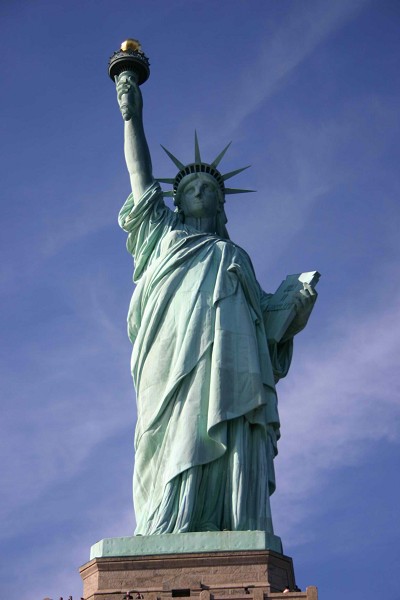
The Statue of Liberty (Liberty Enlightening the World; French: La Liberté éclairant le monde) is a colossal neoclassical sculpture on Liberty Island in New York Harbor, designed by Frédéric Bartholdi and dedicated on October 28, 1886. The statue, a gift to the United States from the people of France, is of a robed female figure representing Libertas, the Roman goddess of freedom, who bears a torch and a tabula ansata (a tablet evoking the law) upon which is inscribed the date of the American Declaration of Independence, July 4, 1776. A broken chain lies at her feet. The statue has become an icon of freedom and of the United States.
Bartholdi was inspired by French law professor and politician Édouard René de Laboulaye, who commented in 1865 that any monument raised to American independence would properly be a joint project of the French and American peoples. Due to the troubled political situation in France, work on the statue did not commence until the early 1870s. In 1875, Laboulaye proposed that the French finance the statue and the Americans provide the pedestal and the site. Bartholdi completed the head and the torch-bearing arm before the statue was fully designed, and these pieces were exhibited for publicity at international expositions. The arm was displayed at the Centennial Exposition in 1876 and in New York's Madison Square Park from 1876 to 1882. Fundraising proved difficult, especially for the Americans, and by 1885 work on the pedestal was threatened due to lack of funds. Publisher Joseph Pulitzer of the World started a drive for donations to complete the project that attracted more than 120,000 contributors, most of whom gave less than a dollar. The statue was constructed in France, shipped overseas in crates, and assembled on the completed pedestal on what was then called Bedloe's Island. The statue's completion was marked by New York's first ticker-tape parade and a dedication ceremony presided over by President Grover Cleveland.
The statue was administered by the United States Lighthouse Board until 1901 and then by the Department of War; since 1933 it has been maintained by the National Park Service. The statue was closed for renovation for much of 1938. In the early 1980s, it was found to have deteriorated to such an extent that a major restoration was required. While the statue was closed from 1984 to 1986, the torch and a large part of the internal structure were replaced. After the September 11 attacks in 2001, it was closed for reasons of safety and security; the pedestal reopened in 2004 and the statue in 2009, with limits on the number of visitors allowed to ascend to the crown. The statue, including the pedestal and base closed beginning on October 29, 2011, for up to a year so that a secondary staircase and other safety features can be installed; Liberty Island remains open. Public access to the balcony surrounding the torch has been barred for safety reasons since 1916.
